

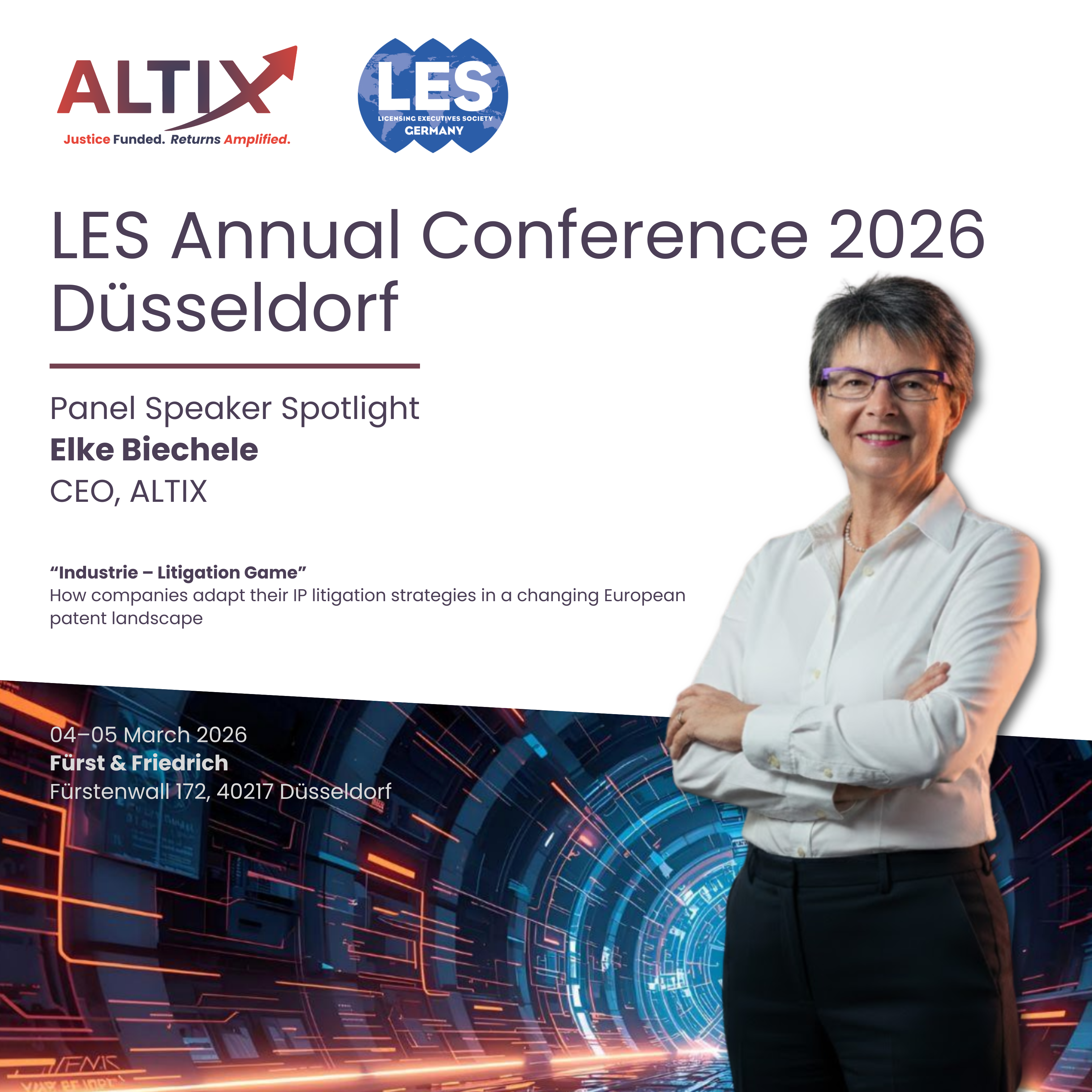
On 04 to 05 March 2026, the Licensing Executives Society Germany will host its Jahrestagung 2026 in Düsseldorf under the theme “Disruption in IP.”
I am honored to join this year’s program as a panel speaker in the session:
“Industrie – Litigation Game”
This is not just another conference discussion. The European patent landscape is undergoing structural change. Courts are becoming more interconnected. Cross border enforcement is more dynamic. Litigation is increasingly strategic, not reactive.
And capital is playing a larger role than ever before.
The Litigation Game Has Changed
For years, patent litigation followed a familiar rhythm. Jurisdiction mattered. Timing mattered. Budget constraints shaped strategy.
Today, the equation is different.
Companies must consider:
- Cross border enforcement implications
- Parallel proceedings and coordinated filings
- The growing influence of AI in patent analysis and evidence
- Financial risk exposure in complex, multi jurisdiction disputes
- The role of external capital in accelerating or defending claims
Litigation is no longer purely a legal exercise. It is a strategic business decision.
That is precisely why this panel matters.
Where ALTIX Fits Into This Conversation
At ALTIX, we operate at the intersection of law, capital, and technology.
We see firsthand how strong claims stall because of funding gaps.
We see how high merit cases can become strategic assets when structured properly.
We see how legal departments are being asked to manage risk more like investment portfolios.
Litigation finance is no longer viewed as a last resort. It is increasingly a proactive tool:
- To unlock value from dormant claims
- To optimize balance sheet exposure
- To enable enforcement without draining operational capital
- To create alignment between legal strategy and financial performance
This shift is not theoretical. It is already happening.
What I Intend to Bring to the Panel
During the “Industrie – Litigation Game” discussion, I will focus on three core themes:
1. Litigation as an Asset Class
Legal claims, when properly assessed, structured, and financed, can function as strategic assets rather than unpredictable liabilities.
2. Risk Sharing as a Competitive Advantage
Forward thinking companies are exploring models where risk is shared rather than absorbed entirely in house.
3. The Capital Layer in European Patent Strategy
As the European enforcement landscape evolves, access to intelligent capital becomes part of the competitive toolkit.
The companies that understand this shift early will be positioned differently in the next wave of disputes.

Why This Matters Now
The conference theme “Disruption in IP” is timely.
Artificial intelligence is transforming patent drafting and litigation workflows.
The European patent framework continues to evolve.
Cross border decisions increasingly shape enforcement strategy.
But the real disruption may not be technological alone.
It may be financial.
When capital becomes embedded into litigation strategy, the rules change.
A Personal Perspective
Over the years, I have worked closely with founders, in house counsel, and litigation teams who were sitting on strong claims but lacked the financial flexibility to pursue them confidently.
The frustration is rarely about legal merit.
It is often about resources, timing, and risk appetite.
If we want innovation to be protected properly, we must also rethink how enforcement is financed.
That conversation deserves a serious seat at the table.
Let’s Continue the Discussion
The LES Jahrestagung 2026 will bring together judges, in house leaders, patent professionals, and industry strategists.
I look forward to contributing to this dialogue and to learning from fellow panelists and attendees.
If you are active in patent litigation, licensing, or IP strategy, I would welcome your perspective:
What is the biggest strategic shift you are seeing in European patent disputes?
Is capital becoming part of your litigation planning conversations?
The litigation game is evolving. The question is not whether disruption is happening.
The question is how prepared we are to navigate it.