


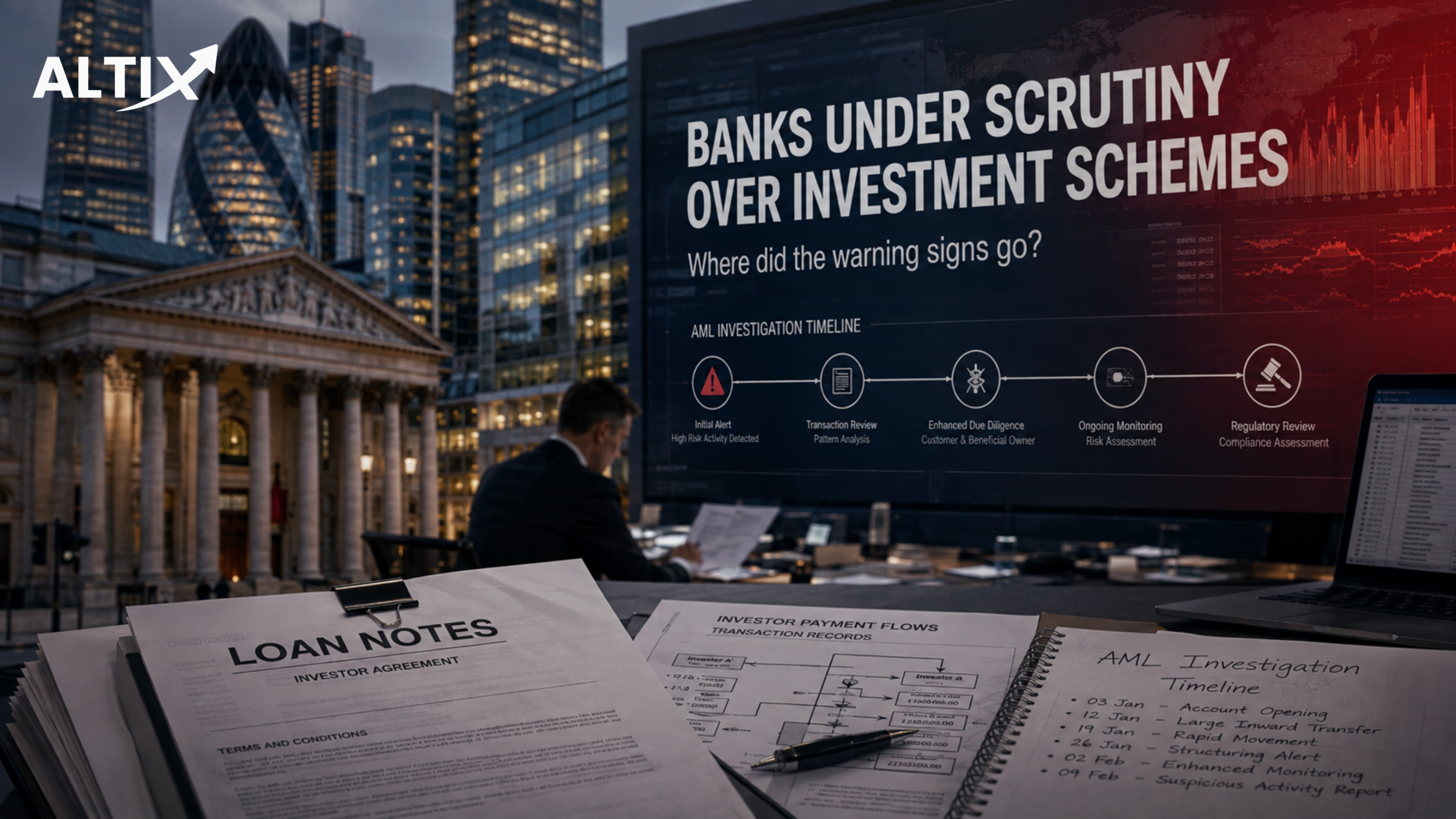
There is a point in many investment fraud cases when the question changes.
At first, everyone asks:
"How did the investors get deceived?"
Then comes the more difficult question:
"How did the money move through the financial system?"
That second question is now at the centre of a growing UK scandal involving high risk, unregulated loan note investment schemes.
Recent reporting has put banks including NatWest, Lloyds and Barclays under scrutiny over their relationships with firms connected to failed investment schemes. The Financial Conduct Authority is also looking closely at the role of banks and their due diligence when processing funds for unregulated investment businesses.
This is not a finding that these banks caused the losses.
It is not proof that a bank is liable simply because an alleged fraudster held an account there.
And that distinction is critical.
But it raises an important question for the financial industry:
When warning signs exist, what responsibility does a financial institution have to recognise, investigate and respond to them?

The 79th Group Story Is Particularly Important
One of the cases attracting attention involves 79th Group, a property and loan note business that has been the subject of an ongoing police investigation.
The FCA confirmed that the City of London Police agreed to investigate the group in September 2024 after concerns were shared with law enforcement. The FCA has also warned that unlisted loan notes and mini bonds can be high risk and that many firms offering them do not require FCA authorisation, meaning investors can have significantly fewer protections.
Recent reporting has alleged that substantial amounts of investor money continued to pass through banking accounts associated with the group despite warnings and other developments.
Those allegations will need to be properly tested.
But from a financial crime perspective, the question is fascinating.
Because money does not move invisibly.

What Does a Bank Actually See?
Having worked inside banking, I know there is an important distinction between what looks suspicious in hindsight and what was reasonably identifiable at the time.
That distinction matters enormously.
A single payment may look completely ordinary.
A series of payments may tell a different story.
A company receiving millions from individual investors may create a different risk profile from an ordinary operating business.
Payments to related entities can create another.
Large volumes of incoming investor funds followed by transfers elsewhere can create another.
This is why AML and transaction monitoring are not simply about spotting one "bad" transaction.
They are about understanding patterns.
And patterns become especially important when an investment business is dealing with large numbers of customers and significant amounts of money.

The Question Is Not "Why Didn't the Bank Stop It?"
This is where conversations about bank accountability often become too simplistic.
Banks are not regulators.
Banks are not courts.
Banks cannot automatically know that every investment being offered by a customer is fraudulent.
And a bank account existing does not mean that the bank has endorsed the underlying investment.
The more useful question is:
What information was available to the institution at the relevant time, and how did its systems and people respond to that information?
That is a much more sophisticated question.
It can involve:
- customer due diligence
- transaction monitoring
- account activity
- source and destination of funds
- unusual payment patterns
- internal alerts
- relationship management
- escalation procedures
- communications with other institutions
- regulatory warnings
- suspicious activity reporting
This is where financial investigations become essential.
Hindsight Is Not Evidence
One of the biggest mistakes in financial dispute work is looking backwards and assuming that everything should have been obvious.
It rarely is.
A transaction that looks suspicious after a fraud collapses may have looked ordinary when it happened.
That is why a credible investigation needs to reconstruct the timeline.
What happened?
When did it happen?
What information existed at each stage?
Who had access to that information?
What systems generated alerts?
What decisions followed?
And what happened to the money afterwards?
Only then can a claimant begin to distinguish between an unfortunate loss and a potentially actionable institutional failure.
The AML Perspective
From an AML perspective, the most interesting part of these cases is often not the original investment pitch.
It is the financial behaviour around it.
Where did investor money accumulate?
Were accounts being used in ways consistent with their stated purpose?
Did transaction volumes materially change?
Were funds rapidly moved between related entities?
Were there unusual international transfers?
Were there patterns that would reasonably have triggered enhanced scrutiny?
Again, these questions do not establish liability.
They establish what needs to be investigated.
And that is a crucial distinction.

Where Investment Fraud Becomes a Financial Dispute
Once investors have lost money, the case can move beyond criminal investigation.
There may be claims against the operators.
Claims against directors.
Claims involving intermediaries.
Potential recovery from assets.
Questions concerning professional advisers.
And, depending on the evidence and applicable law, disputes involving financial institutions.
Each pathway has different legal requirements.
Each requires different evidence.
That is why sophisticated investment fraud recovery cannot rely on one investigation or one legal theory.
The Financial Trail May Be More Valuable Than the Sales Pitch
The investment prospectus tells you what investors were promised.
The banking records can tell you what actually happened.
That difference can be enormous.
A sophisticated financial investigation can reconstruct the movement of funds across:
Investor → Bank → Investment Company → Related Entity → Asset → Another Account
Or potentially much more complicated structures involving multiple jurisdictions.
The objective is not simply to produce a transaction spreadsheet.
It is to reconstruct the economic reality of the scheme.
That can help lawyers identify potential defendants, recovery targets and evidential gaps.

Why Litigation Finance Matters
There is another uncomfortable reality.
Investigating a complex investment fraud can be expensive.
Obtaining records.
Tracing assets.
Instructing forensic specialists.
Engaging lawyers across jurisdictions.
Bringing claims.
Enforcing judgments.
For an individual investor, the economics can make pursuing recovery extremely difficult.
This is one reason litigation finance has become increasingly relevant to financial disputes.
Where a claim has sufficient merit and recoverable value, funding can provide the resources required to investigate and pursue it.
The objective is not to turn every fraud into litigation.
It is to ensure that potentially strong claims are not abandoned simply because the victims cannot afford the process.
The Bigger Lesson for Banks
There is also a lesson here for financial institutions.
Fraud prevention cannot be treated as a compliance checklist.
It is an operational responsibility.
The most effective systems combine:
Technology + AML intelligence + human judgement + escalation.
And when something goes wrong, institutions need to be able to demonstrate how those controls actually operated.
That is increasingly important as regulators and courts examine financial crime through the lens of institutional accountability.
What Investors Should Take From This
The biggest lesson is not that banks are responsible for investment losses.
They are not automatically.
The lesson is that the financial institution should not be treated as irrelevant either.
When a major investment fraud occurs, the bank may hold some of the most important evidence in the entire case.
Transaction histories.
Account records.
Payment instructions.
Counterparty information.
Internal communications.
Compliance records.
Those records can help establish what happened and when.
This Is Where Banking Experience Matters
Having worked inside banking and financial crime, I have seen how different the financial system looks from the inside compared with the outside.
A victim sees a transfer.
A bank sees an account relationship, transaction history, risk profile, payment behaviour and potentially multiple internal controls operating around that transaction.
That institutional perspective can make a significant difference when investigating a complex financial dispute.
At ALTIX, this is one of the areas where our experience becomes particularly relevant.
We are not approaching financial disputes simply as claims on paper.
We look at the underlying financial infrastructure.
Where did the money go?
What institutions touched it?
What evidence exists?
What recovery routes remain?
And what resources are required to pursue them?
The Recovery Conversation Is Changing
The UK loan note scandal is an important reminder that investment fraud recovery is evolving.
The conversation is moving from:
"Who was the scammer?"
to:
"What happened across the entire financial ecosystem?"
That includes promoters.
Intermediaries.
Investment businesses.
Banks.
Payment providers.
Professional advisers.
And ultimately, the legal and regulatory frameworks that determine accountability.
Not every case will result in a claim against a bank.
But every serious case deserves an evidence based investigation before that question is dismissed.
The latest scrutiny of UK banks should not be interpreted as proof that banks are responsible for every investment fraud.
It should be viewed as a reminder that financial institutions sit within the chain of events through which money moves.
And when significant losses occur, understanding that chain can be critical.
The investors affected by these schemes deserve more than an explanation of how they were deceived.
They deserve to know where their money went.
They deserve to understand what evidence exists.
And where there is a viable legal pathway, they deserve access to the resources needed to pursue recovery.
At ALTIX, we bring together banking, AML, financial investigation and litigation finance expertise to help assess complex financial disputes and identify structured recovery pathways.
If you are an investor facing significant financial losses, a law firm handling an investment fraud matter, or an investigator looking for a funding partner, contact ALTIX to discuss the case and the available recovery options.
The first question is not always who should pay.
Sometimes, it is simply:
Where did the money go, and who had the opportunity to see it?
Sources
The Times, reporting on banks facing scrutiny over alleged missed warning signs in high risk loan note schemes.
Financial Conduct Authority, information released concerning the 79th Group investigation and the risks associated with unregulated loan notes and mini bonds.
Companies House records concerning the administration of Godwin Capital entities.